
The Turn of the Tide
Seasons, stories and other wonders...

Cyanotype
Cyanotype - history and process
The Victorian Era was a time of incredible invention, from the steam engine and stage coach to the telephone, sewing machine and typewriter. There were great discoveries in medicine such as anaesthesia, x-rays and new vaccines, advances in geology, palaeontology and astronomy, and new scientific theories such as evolution, fluid mechanics and electromagnetic induction, that laid the foundations for modern science.
Before the Victorian age images could only be created by painting or drawing. 'Frustrated by his lack of artistic ability, William Henry Fox Talbot began searching for a way to 'fix images'. After some experiments Talbot took an image of a window at his home, Lacock Abbey, in 1835. This image, not much bigger than a postage stamp, is now celebrated as the world’s earliest surviving photographic negative.' [1] Fox Talbot's photographs were created using salt, silver chloride and sunlight.
Instead of salt, Sir John Herschel discovered that sodium thiosulphate was a better fixing agent for images – this is the solution still used to fix photographs today. Hershel coined the term ‘photography’ in 1839.
Sir John Herschel, born in Slough, was an English scientist, mathematician, astronomer, chemist, inventor and botanist. He proposed the names still used today for the seven then-known satellites of Saturn: Mimas, Enceladus, Tethys, Dione, Rhea, Titan and Lapetus. He also proposed the names still used today for the four then-known satellites of Uranus: Ariel, Umbriel, Titania and Oberon. He is buried in Westminster Abbey next to Charles Darwin whom he influenced. [2]
Herschel experimented with other ways of making images and in 1842 he discovered the Cyanotype process, which became known as blueprints and was used widely by architects to make copies of their plans. [3]
Cyanotypes use a non-toxic emulsion made from two iron salts, ferric ammonium citrate and potassium ferricyanide. Dissolve these two iron salts in water, mix them, and they form a light-sensitive solution which changes colour when exposed to ultraviolet light / sunlight. When the exposed chemicals are washed away with water, the resulting areas will be a deep Prussian blue, with the unexposed areas or drawing remaining the colour of the paper, usually white.

Anna Atkins was an illustrator and photographic pioneer born in Kent, England. Her mother died when she was a baby. She was raised by her father, the naturalist John George Children. Who gave her a scientific education not available to most women at that time.
Anna was particularly interested in biology and plants. Between 1822 and 1824 she made 250 engravings to illustrate the English translation of Jean-Baptiste de Lamarck’s Genera of Shells (1833). She continued to combine her scientific knowledge and artistic skills.
-3.jpg)
Sir John Frederick William Herschel, 1st Baronet (1792 – 1871)

An illustration to Jules Verne's novel Hector Servadac from 1877 shows Herschel observing Halley's Comet in 1835 in Cape Town. Engraving by Charles Laplante after Paul Philippoteaux
Anna Atkins (1799 - 1871)
In 1839, Anna was elected a member of the London Botanical Society, one of the few scholarly societies that accepted women, enabling her to further study botany. Algae was much harder to store and study than plants and flowers, quickly drying out and decaying when removed from its natural environment. Anna overcame this problem using the new photographic technologies being pioneered by Sir John Herschel and William Henry Fox Talbot. Using the latest technology - Cyanotype - she produced images of incredible beauty and detail, and great value to botanical study.
"The difficulty of making accurate drawings of objects as minute as many of the Algae and Confera, has induced me to avail myself of Sir John Herschel's beautiful process of Cyanotype, to obtain impressions of the plants themselves," Anna Atkins,1843 [4]
Initially alone, and then with her friend Anne Dixon, she produced well over 10,000 copies of astonishingly original and delicate photograms and assembled them in several books like albums.
Her book 'Cyanotype Impressions', containing cyanotypes of British algae, was published in 1841. It is considered the first ever book to be illustrated with photographic images.
Today her cyanotypes inspire creativity all over the world. They are treasured by museums and libraries whose digitised collections allow us to view Anna's work online, see the New York Public Library and The Getty Museum,USA.

[2] https://en.wikipedia.org/wiki/John_Herschel#cite_note-FOOTNOTESchaaf197947%E2%80%9360-31
[3] https://www.archisoup.com/studio-guide/architectural-blueprints
A few of my cyanotypes


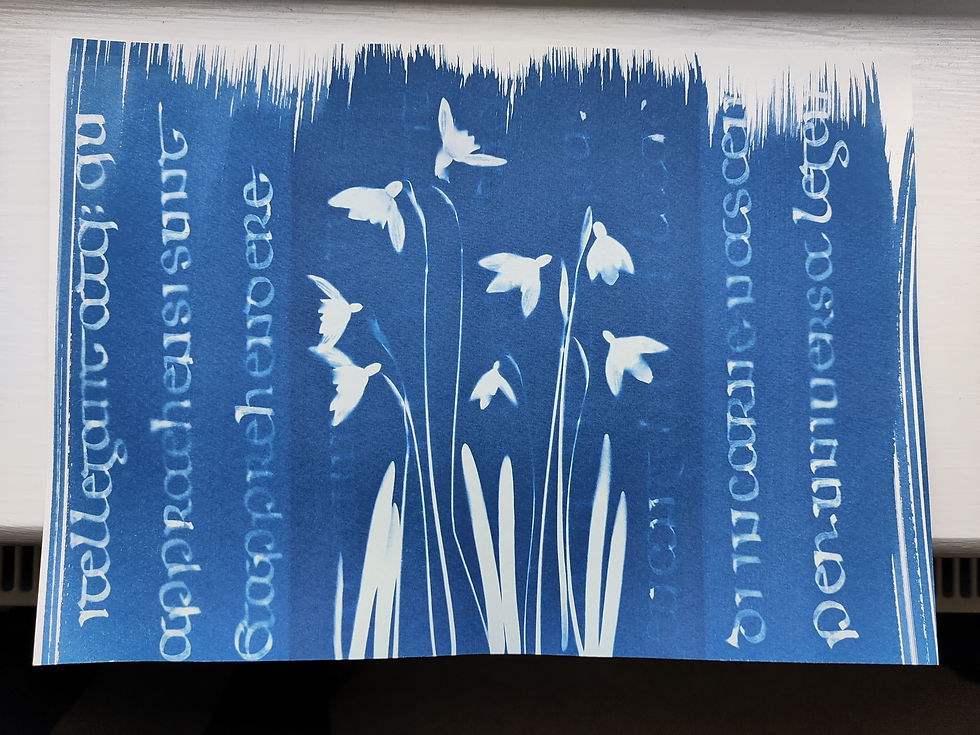


The deeper the blue becomes, the more strongly it calls man towards the infinite, awakening in him a desire for the pure and, finally, for the supernatural... Wassily Kandinsky